Looking at the Whole Person
I always knew I wanted to care for people, and despite my love for biology, my attempt at pre-med fell flat. I got good grades and I was fascinated by the material, but I couldn't shake the feeling that medicine was missing the whole point: what it is to be human.
I didn't want to fix the parts.
I wanted to nurture the whole.
So I went to grad school for social work. It gave me the two lenses I still use every day:
Person in environment.
You can't understand a person in a vacuum. We live inside concentric circles of relationship: with ourselves, our partners, our neighbors, our city, and our culture. When one ring falls out of health, the whole ecosystem warps around it.
Squad-scale rooms.
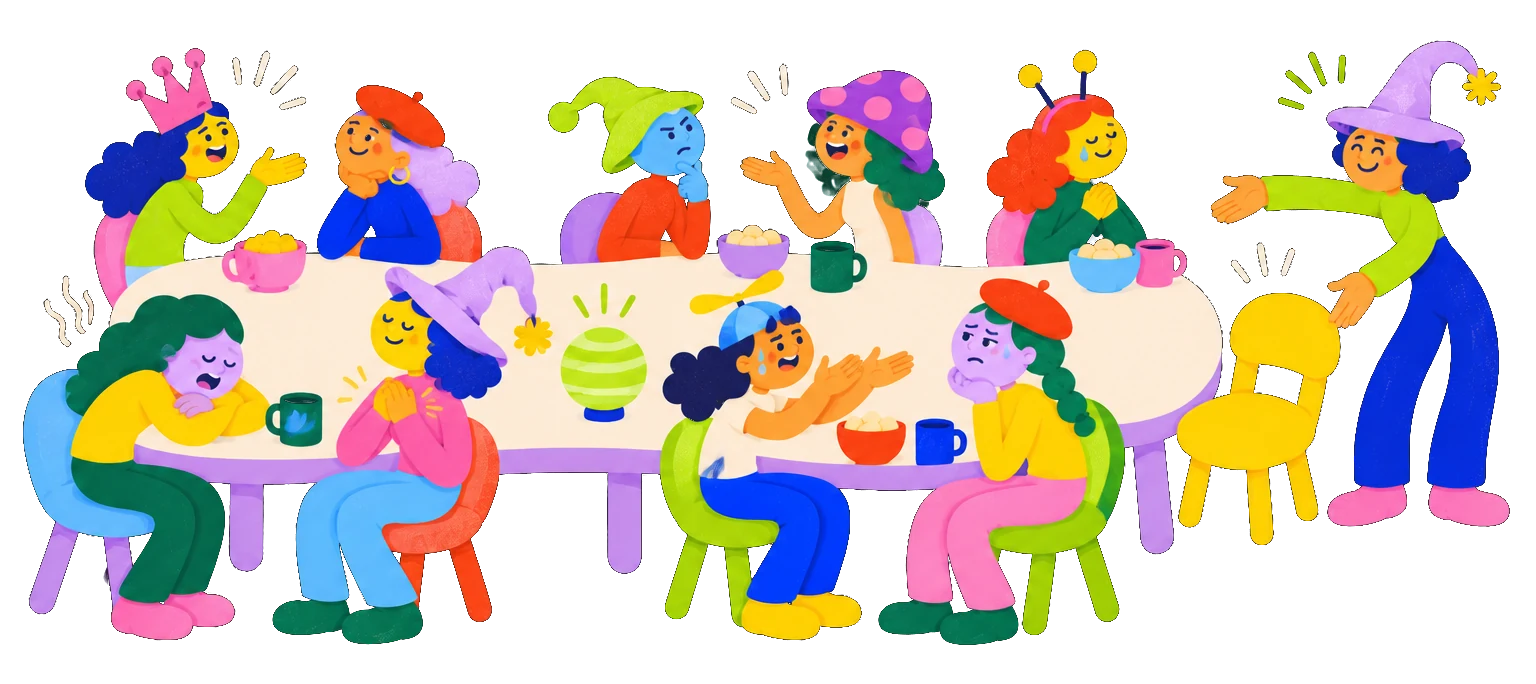
I learned that my favorite medium is a small group of six to ten people. I love doing all the invisible prep ahead of time so that when people walk through the door, the room just flows.
Getting the Right People in the Room
Social work launched me into the world of health policy. I was an associate director at a think tank in Chicago, working on systems of home & community-based care for older adults and people with disabilities. In 2009, we were at a threshold with new statewide policies ushering in a new era of care.
So I did what I still do: I got the right people in the room. State government officials, providers, the people receiving care, and analysts like me. We brought in outside experts to learn from, put the right information and a clear agenda on the table, and I convened the steering committee that pulled it all together.
That room didn't write a report. It built a health plan.
Together, we co-founded the Community Care Alliance, a living lab for how that policy could actually work, serving nearly 10,000 people on Medicare and Medicaid. I first served on the founding board and later on staff. It was acquired in 2019.
Later, at IBM Watson Health, I brought the same approach to the national stage, working with federal and state governments on Medicaid programs that reach millions of people. One of my biggest projects was a federal value-based care initiative, built around the questions I'm still asking today: what do we value? What's healthy for people?
The Same Invisible Glue
The care I worked on in health policy happens in living rooms and kitchens, when friends, neighbors, and family look after each other.
In the United States, that informal care is worth $1 trillion every single year.
It's the glue holding society together, and to the market, it barely exists.
Relational work is the same glue.
Relational First, Technology Second
If the market can’t see this glue, could technology help? That’s the question behind the relational tech R&D lab I co-founded, experimenting with blockchain and AI. We started from the social side (what are we trying to help people do together?) and only then picked up the technology.
That's how Exquisite Land was born: a giant collaborative drawing game, built on-chain, pixel by pixel. Its pixel editor went on to become Exquisite Graphics, a public good that other artists still build with.
Decide what you're doing for people first. Then pick up the tools.
Why Relational, Why Now
Everywhere I go, I meet relational founders and artists working at the next frontier of value.
- Lindsey, building a method for unlearning what the industrial age told us to be, so we can be who we actually are in the next one.
- Mathilde, gathering people for conversations about raising kids in the AI era.
- Anthony, building an interactive magazine so kids don't forget the joy of making things by hand.
They're doing the work our isolated, hyper-online world is starving for. The market can barely see it.
So Dave and I started Relational. I lead the room: I can feel what's alive in a founder's work even when it's still a tangle in their head, and I know how to build the container around it.
Dave brings the technical landscape: how new tools shape the way people relate. That lets our founders use what's emerging without losing the relational agenda.
Let's Make the Invisible Visible
Relational is where I'm putting everything I've learned: a founding cohort of 6 to 10 founders and artists building the next chapter of culture.
Whether you're building this work or backing it, if you've been looking for the people leading the next push in relational culture, you've found us. The empty chair is yours.